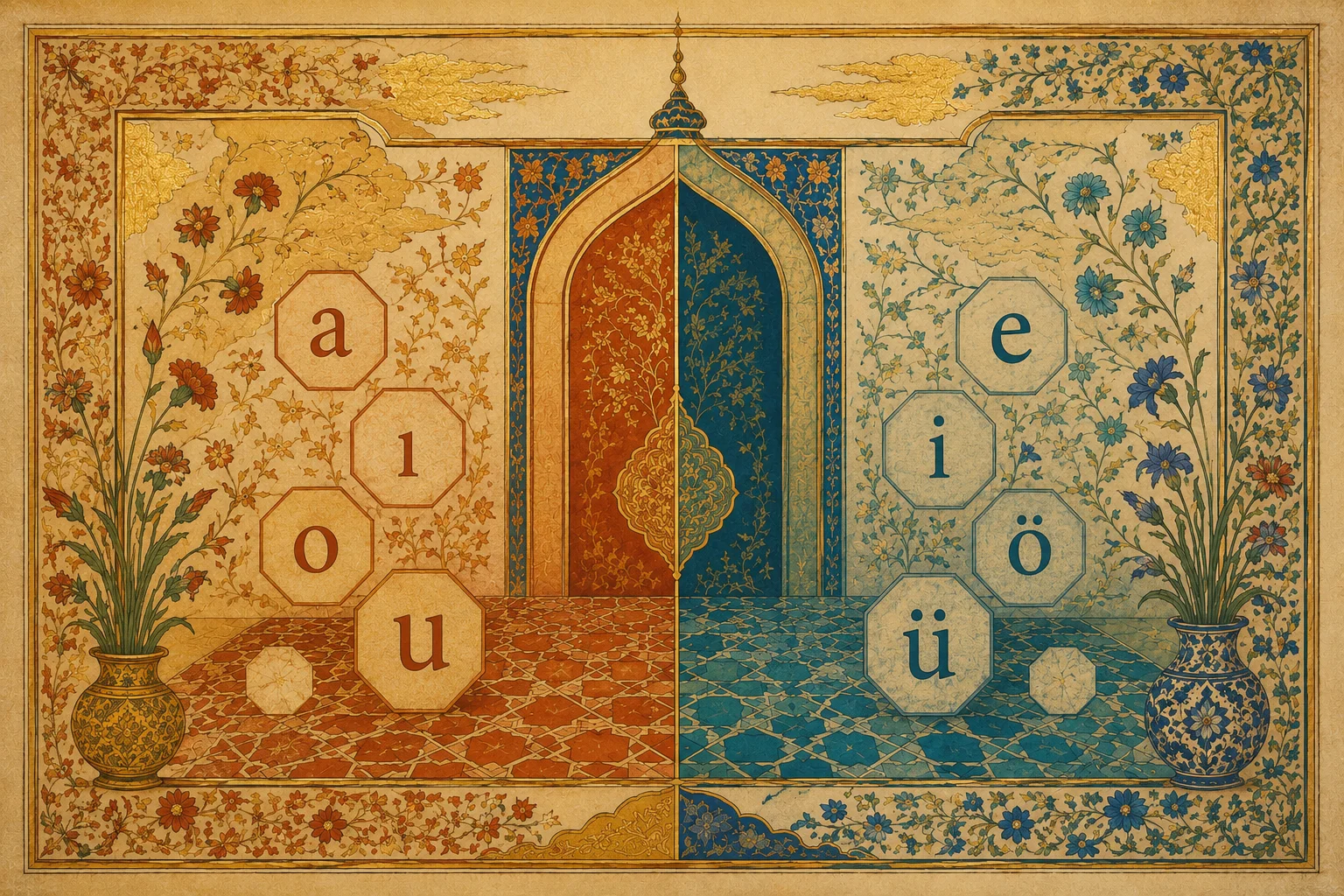
Most grammar rules add complexity. Turkish vowel harmony removes it.
Turkish suffixes change their vowels depending on the last vowel of the word they attach to. When you first learn this, it sounds like one more thing to memorize. But then something clicks: once you internalize the system, your mouth starts producing the right vowel before your brain has to think about it.
How it works
Turkish vowels split into two camps:
Back vowels: a, ı, o, u (your tongue sits low and back)
Front vowels: e, i, ö, ü (your tongue sits high and forward)
When you add a suffix to a word, the suffix's vowel matches the camp of the last vowel in the stem. The suffix doesn't have a fixed form. It shifts to harmonize.
The plural suffix, for example, is -lar after back vowels and -ler after front vowels:
- kitap (book) → kitaplar (books) = back vowel, so -lar
- ev (house) → evler (houses) = front vowel, so -ler
The locative suffix is -da after back vowels and -de after front vowels:
- okul (school) → okulda (at school)
- ev (house) → evde (at home)
That's it. Back attracts back. Front attracts front.
Why it's easier than it sounds
Back vowels and front vowels feel different in your mouth. Say okulda out loud. Your mouth stays relaxed, open, back. Now say evde. Your tongue moves forward, your lips change shape. The vowels within each word belong to the same physical neighborhood.
Now try saying evda. Your tongue has to jump from a front position (e) to a back position (a). It feels wrong. Physically wrong, like your mouth is tripping over itself.
That's vowel harmony working as a feature, not a bug. The system exists because it makes pronunciation smoother. Each word keeps your tongue and lips in roughly the same neighborhood instead of making them jump back and forth. When Turkish learners stop thinking about harmony rules and start feeling them, they start trusting the physical discomfort of disharmony as a signal. Correct forms come faster.
Four-way harmony
Some suffixes have four variants instead of two. The possessive suffix, for instance, harmonizes not just for front/back but also for rounded/unrounded:
- ev (house) → evim (my house) = front, unrounded → i
- göz (eye) → gözüm (my eye) = front, rounded → ü
- kol (arm) → kolum (my arm) = back, rounded → u
- at (horse) → atım (my horse) = back, unrounded → ı
Four options sounds like a lot. But the logic is the same: the vowel matches what your mouth was already doing. If you just said a front rounded vowel (ö in göz), your mouth naturally rounds for the suffix too (ü).
Turkish vowel system
The last vowel of the stem fixes the suffix vowel.
2-way suffix
plural -lAr, locative -DA
evler · okulda
4-way suffix
possessive -Im
evim · gözüm · kolum · kızım
The exceptions (there are always exceptions)
Loanwords often arrive "disharmonic," meaning their vowels don't all belong to the same front/back family. Kitap (from Arabic) has a back vowel a but its borrowed form doesn't fully harmonize internally. Televizyon mixes front and back vowels in one word. Most of these have settled into ordinary Turkish vocabulary and pass without comment, but the disharmony is audible enough that suffix selection on some loanwords still wavers.
English used to do something related
A thousand years ago, English had a related Germanic process called i-mutation (also called umlaut). Mouse → mice. Foot → feet. Goose → geese. Tooth → teeth. Those plurals are fossils: the plural suffix was originally -iz, and that i pulled the stem vowel forward to match it. Mūs + iz became mȳs. The suffix later dropped off, but the vowel change stayed.
This isn't full Turkish-style vowel harmony. It was a one-time assimilation that became fossilized, not a productive rule applied across the morphology. But the instinct is the same: a vowel reaching across a morpheme boundary to match a neighbor. Turkish kept that instinct alive, predictable, and productive across thousands of suffixes. English kept a handful of irregular plurals and lost the rest of the system.
The bigger picture
Vowel harmony isn't unique to Turkish. Finnish has it (front/back split). Hungarian has it (with "transparent" vowels that complicate things). Mongolian, Kazakh, and Kyrgyz have it. Uzbek, interestingly, lost it after centuries of contact with Persian eroded the harmonic system, making Uzbek the famous exception among its Turkic relatives. The rest of the Turkic and Uralic families keep harmony alive, and the purpose is always the same: make pronunciation flow.
For learners, vowel harmony is the rare grammar rule that rewards physical intuition over intellectual analysis. Learn the rule once, then forget it and trust your mouth. The discomfort of disharmony will guide you better than any flashcard.
Mouse → mice isn't the only fossil in English. Why every language keeps these relics, and why they cluster around the words you use most: Every Language Has Irregular Verbs →