If you've spent any time in language learning communities, you've heard the advice:
"You need comprehensible input. Read books. Watch shows. Immerse yourself."
The theory behind this is solid. Stephen Krashen's Input Hypothesis, developed in the 1980s, argues that we acquire language not by studying rules, but by understanding messages. When you read or hear language that's mostly comprehensible, with just a bit that's new, your brain does the work of filling in gaps, noticing patterns, building intuition.
What "comprehensible" feels like
Same sentence, different fractions of unknown words.
El perro de mi vecino ladra todas las noches y no me deja dormir
Too many gaps to follow what's happening.
El perro de mi vecino ladra todas las noches y no me deja dormir
One unknown word per sentence. Context fills the gap.
El perro de mi vecino ladra todas las noches y no me deja dormir
Comfortable, but nothing new to acquire.
Decades of research support this. Learners who read extensively outperform those who only do grammar drills. Vocabulary acquired in context sticks better than vocabulary memorized from lists. The more input you get, the better you get.
So the theory is right. The science is settled.
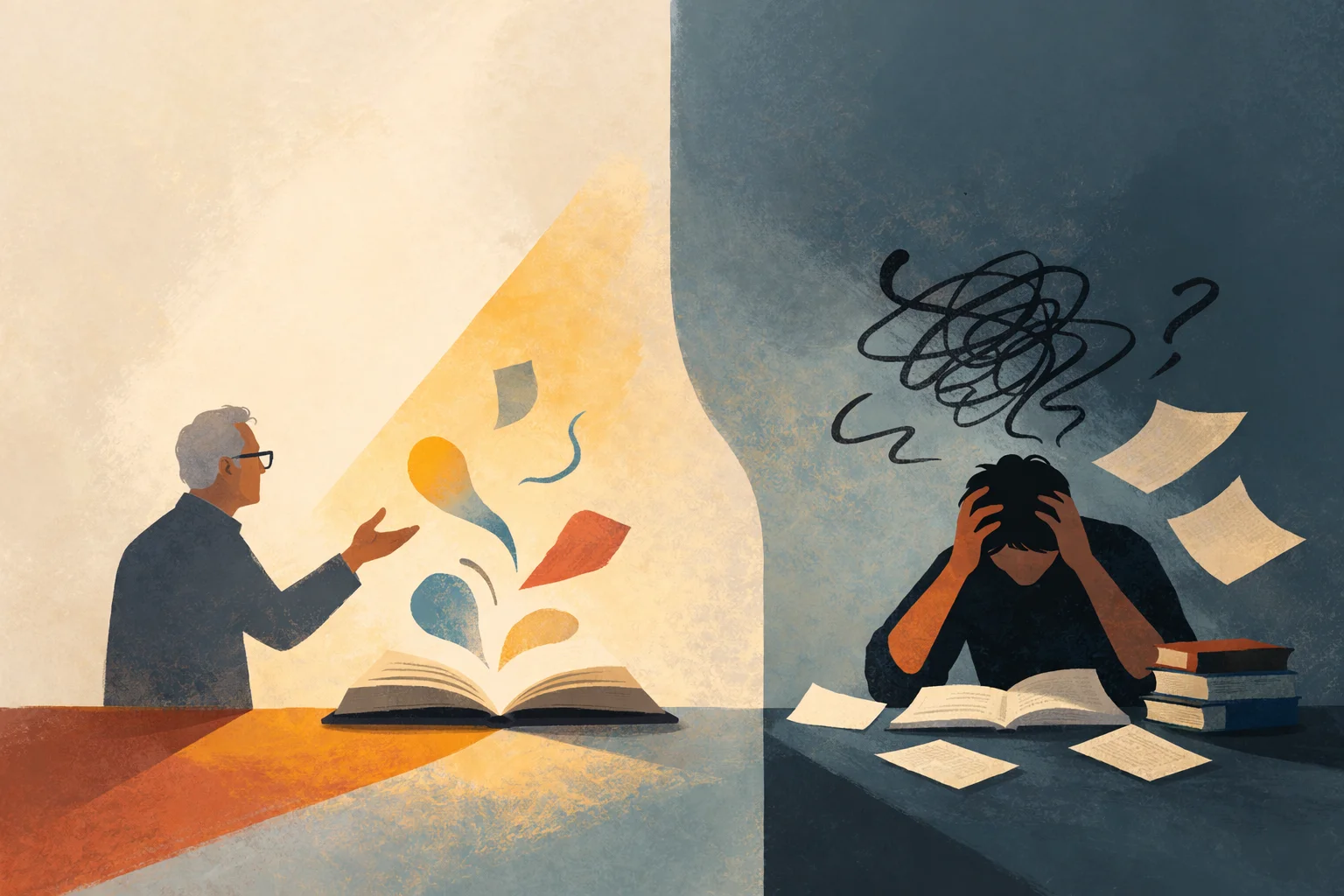
The advice, however, is useless.
The problem with "just read"
"Read books in your target language."
Okay. Which books?
If you're learning Spanish and you're somewhere around A2 or B1, your options are:
- Children's picture books (boring, and weirdly hard because they assume cultural knowledge)
- Native novels (incomprehensible, and you're looking up every third word)
- A handful of graded readers from the 1990s about topics you don't care about
"Watch shows with subtitles."
Which shows? The dialogue moves at native speed. You catch fragments. You spend more time reading subtitles than acquiring language. It's exhausting, and studies suggest passive watching with subtitles doesn't transfer well to actual comprehension.
"Immerse yourself."
In what? You don't live in the country. You don't have native speaker friends. Your "immersion" options are podcasts you can't follow and news articles that might as well be in code.
The advice assumes the content exists. It doesn't.
The graded reader graveyard
There was a time when graded readers were a real industry. Publishers produced simplified versions of classics, original stories written at controlled vocabulary levels, series designed to take learners from beginner to advanced.
Most of that stopped decades ago.
The economics didn't work. Each book served a narrow slice of learners (one language, one level, one topic). Markets were small. Print runs were expensive. Publishers consolidated or shut down their language learning divisions.
What remains is sparse: a few series still in print, some dated titles from the 60s and 70s, a smattering of newer options in major languages. For less commonly studied languages, there's almost nothing.
The digital era made this worse in some ways. Everyone assumed the internet would solve the content problem. Just find authentic material online! But authentic material isn't graded. A blog post, a news article, a Reddit thread: none of it is calibrated to your level. It's either too easy (you learn nothing) or too hard (you give up).
The adult advantage
Here's something the "just immerse yourself" crowd often misses: adults don't learn like children, and that's actually good.
Children acquire language through pure exposure over thousands of hours. They have time. They have neuroplasticity. They have patient caregivers who simplify their speech and correct mistakes gently.
Adults have none of that. But they have something else: the ability to understand and apply explicit rules.
Research consistently shows that in instructional contexts, adults learn grammar faster than children. A Penn State study using an invented language found adults were both more accurate and faster than children, and explicit training improved performance for both groups.
This is where Skill Acquisition Theory comes in. Psychologist Robert DeKeyser describes language learning in three stages: first you learn a rule explicitly (declarative knowledge), then you practice applying it (procedural knowledge), then it becomes automatic. Adults can shortcut the first stage through instruction, then use input to proceduralize and automatize.
The upshot: pure input works, but input plus explicit knowledge works faster for adults. When you read a sentence and notice "oh, that's the subjunctive because there's doubt in the main clause," you're accelerating what would otherwise take thousands of exposures to internalize unconsciously.
The best approach isn't Krashen versus grammar drills. It's both: massive input, with just enough explicit scaffolding to help you notice patterns.
Learning to play the game
But there's something deeper going on than vocabulary and grammar.
The philosopher Ludwig Wittgenstein argued that language isn't a set of rules you memorize. It's a practice you learn to participate in. He called these practices "language games." You don't understand a word by looking up its definition; you understand it by seeing how it's used, in what contexts, with what expectations.
Consider: "How are you?"
Every learner knows what these words mean. The grammar is trivial. But it takes real exposure to understand that this isn't a question. It's a ritual. The expected response is "Fine, you?" not an honest accounting of your emotional state. Answering sincerely marks you as foreign instantly.
Or imagine explaining to someone who's never played poker why "I'll see your bet" is funny when said sarcastically during an argument. You can translate every word. The grammar is trivial. But without hundreds of hours of movies, TV shows, and conversations where you've absorbed how English speakers invoke poker metaphors, you'd just stare blankly.
You understood every word. You missed the game.
This is why input matters in a way that flashcards and grammar tables never can. You're not just learning vocabulary. You're learning when to use it, how to use it, what it signals, what game you're playing. That knowledge doesn't come from rules. It comes from exposure.
The real bottleneck
Here's what doesn't get said enough: the bottleneck for most intermediate learners isn't motivation, method, or time. It's material.
You know what to do. Read more. Get input. Acquire vocabulary in context.
You just can't find anything to read.
The gap between "lesson content" (textbooks, apps, courses) and "native content" (books, shows, articles) is a chasm. Crossing it requires either grinding through incomprehensible material until it becomes comprehensible (slow, painful, high dropout rate) or finding the mythical "content at your level" that barely exists.
This is the discontent. Not with the theory. Krashen was right. The problem is the lack of infrastructure to apply it.
What would actually help
The ideal would be content that:
- Matches your level: not too easy, not too hard
- Covers topics you care about: not just "María goes to the market"
- Exists in sufficient quantity: you need volume, not just a few books
- Adapts as you improve: what's right for you today won't be right in three months
- Surfaces the rules when you need them: tap a word, see the conjugation, notice the pattern
That last point matters. The adult advantage only works if you can access explicit knowledge while getting input. Reading a story and then separately reviewing grammar tables doesn't help you notice patterns in context. The scaffolding needs to be embedded in the reading experience itself.
Traditional publishing can't do this. The economics don't work. You can't print a book for every combination of level, language, and interest, let alone make every word tappable with grammar notes.
But the constraints that killed graded readers were print constraints. Fixed content, fixed levels, fixed topics, static pages.
What if content could be generated to match the learner? What if the scaffolding could be built into the reading experience? What if you could get massive input and notice patterns and look up what you need without breaking flow?
This is where things get interesting.
Reading works. The science is clear. The challenge was never the method. It was finding material that lets you actually use it.
The learners who break through the plateau aren't the ones with better discipline or secret techniques. They're the ones who found something they could actually read.
Polli generates stories at your level, on topics you choose. It's the graded reader that adapts to you. Try it free →